
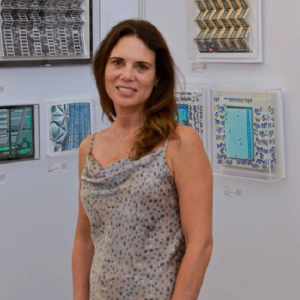
Biography
Gysel Fernandini was born in Lima, Peru, in 1972. She studied Architecture and Urban Planning at Ricardo Palma University and developed her professional career as an architect and interior designer for more than twenty years in cities such as Lima and Miami.
Her passion for photography began during childhood. She often accompanied her mother to a workshop filled with fabrics, where she and her brother played with scraps and different materials. She also grew up surrounded by architectural plans and colonial objects that were transformed into furniture for the family home.
This process of reinventing the past is reflected in the collage work she incorporates into her photographs, integrating new perspectives, materials and visual structures.
In 2016, she immersed herself fully in photography and began developing her technical and artistic training. Since then, she has continued exploring light, volume, depth and perspective.
Her artistic process combines techniques inspired by dioramas and architectural models, creating works that merge the static with the dynamic and introduce movement across surfaces composed of multiple layers and reliefs.
Her images establish a dialogue with the three-dimensional world, inviting viewers to experience not only the central subject, but also a visual journey through buildings, swimming pools, stairways and landscapes inspired by her travels.
Each piece is produced through a detailed manual process of cutting, folding and assembling. Every artwork takes on a life and character of its own. Although created as limited series, no two pieces are exactly alike because the handcrafted process can never be repeated in the same way.
She is currently completing an artistic internship with renowned Venezuelan kinetic artist Juvenal Ravelo, intervening his works under his guidance and transforming them into three-dimensional pieces through her own distinctive technique.
Retroverso
Within that silence, the image becomes almost abstract. Yet silence holds secrets. When you move closer, you begin to discover life: the transparency of the windows, the reflections, and the layers that reveal themselves only when you take the time to pause.
From the reverse side of the photograph, through collage, color returns — not as decoration, but as a reflection of the life that the building still contains. Then something else happens: the viewer sees themselves. The spectator encounters their own reflection within the artwork and, without realizing it, becomes part of it.
Retroverso is an invitation to look slowly and to discover that behind every image there is always something more.
When I choose a photograph, the first thing I do is return it to its origin. I strip away the color and reduce its geometry to black and white, as though it were becoming a plan, a sketch, or the first line drawn by the person who imagined it.