
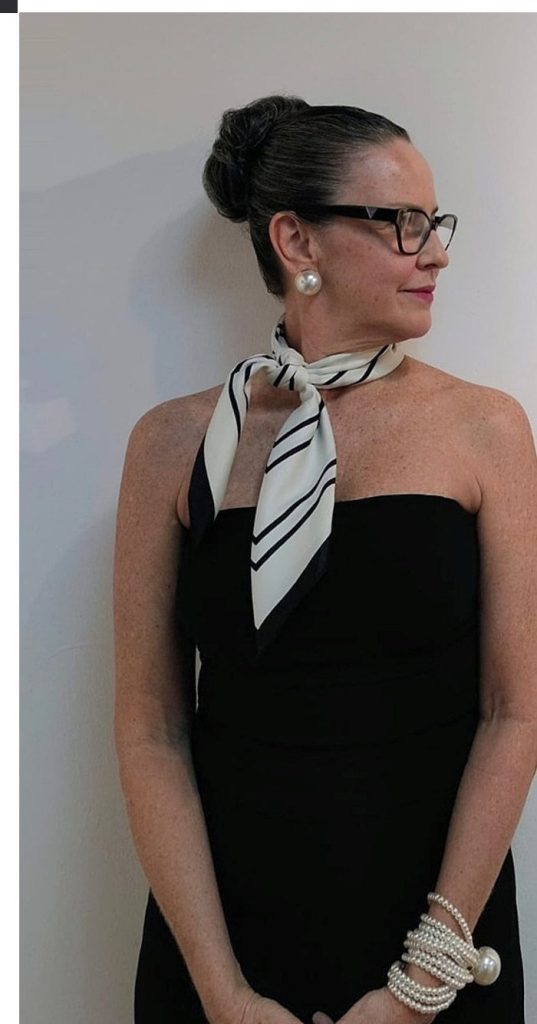
Artist statement
I work with ink, oil pastel, water-soluble graphite, and water-soluble colored pencils on paper (A3 to A5), as well as acrylic on canvas (60 × 40 cm).
On paper, I develop organic abstractions whose patterns resonate with structures found in nature. On canvas, against the backdrop of the Estero Salado, I explore archetypal figuration with surrealist affinities.
Biography
María Rosa Pólit (Guayaquil, b. 1971) lives and works in Guayaquil. She studied Social Communication at what is now Universidad Casa Grande and worked in television, radio and print media. From 2001 to 2003 she was part of the communications team of the Cultural Directorate of the Central Bank of Ecuador in Guayaquil, where she contributed to the promotion of the Museo Antropológico y de Arte Contemporáneo (MAAC).
She studied visual arts at the Instituto Tecnológico Superior de Artes del Ecuador (ITAE) from 2008 to 2010. In 2025 she began her artistic practice and has since produced more than sixty works on paper, several of which are held in private collections.
In 2026 she painted her first canvas, Donde nacen los espíritus (Where Spirits Are Born), which received an Honorable Mention at the LXVII Salón Nacional de Pintura 2026 “Independencia de Guayaquil” (Salón de Octubre) of the Casa de la Cultura Ecuatoriana, Núcleo del Guayas.
Labyrinths (Laberintos)
One day, I decided to draw a spiral. Nothing more, with no rules or expectations. I drew it with a fineliner, without a sketch, and mazes began to emerge from it. They grew without a center, entrance, or exit, like a rhizome. I had never created these kinds of patterns before, and I was surprised by my own steady hand: intricate, precise work made in mental silence, without getting caught up in thought. The lines flowed cleanly, without corrections.
I made nineteen pieces in A3, A4, and A5 formats. Some feature large spirals shaded in graphite; others have more movement or resemble television static. Later, I recognized affinities with forms found in nature, such as corals and the brain, and with Turing patterns.
For decades, I lived with the feeling of being lost, of inhabiting a labyrinth. Looking at the finished drawings from a distance, I discovered their beauty and, with it, the beauty of my own imperfect and tangled path. From afar, even the dead ends become part of the design.
Spirals (Espirales)
In Laberintos, the spiral appeared as one element within a network. In Espirales, I wanted the entire line to become a spiral traveling outward from the center. I am fascinated by this form because it recurs throughout the physical world: in the petals of a rose, a nautilus shell, and distant galaxies. I also associate it with a recurring pattern in my own experience: life events return, offering the possibility of approaching them from a new perspective.
I draw without sketches and lose track of time, but these pieces demanded an enormous physical effort. Hours of continuous movement made me motion-sick, nauseated, and genuinely dizzy. The line became a visceral force. That is why the series is brief: I could finish only five pieces, all in A5. My body would not let me do more. The finished works bear the trace of that effort: the ink continued to move even as I grew exhausted.
Vesania
Vesania began with a need to make room on paper for disturbance. The unrest arrived before the paper did, and I followed it through gesture. When the silence is stable, I can easily detect the moment it breaks. I remain in the studio with that unease until it runs its course and dissolves.
Using water-soluble graphite, I let the repetitive stroke accelerate and the shapes mutate unpredictably, forming tentacular structures and dense atmospheres reminiscent of expanding toxic smoke. In three pieces, I introduced water-soluble red colored pencil, creating a sharp tension within the composition. The drawings preserve the passage of that turbulence: its intensification, its changing forms, and its eventual dissipation.
Remote Present (Presente remoto)
Presente remoto stems from a childhood exercise: covering bright crayon colors with black and scratching lines into the surface to make the colors reappear. I returned to this gesture using oil pastel. This is the first series in which color takes center stage. I had always believed I knew how to draw but not how to paint. Here, my hand paints, covers, and scrapes. I discovered that I could deeply pigment the paper without building up heavy layers of oil pastel. Scraping leaves a tactile texture, while the underlying colors create optical effects that intensify the image. Some pieces resemble nebulae, as light pierces darkness, like starlight reaching us from the past.
The process led me to think about the relationship between shadow and visibility: what is hidden does not necessarily disappear, but can become perceptible through what covers it. This connection resonates with Jung’s concept of the shadow. The textures also brought back memories of La Avanzada Ancestralista, an exhibition at the MAAC. Although I recognize an affinity with those works, I am drawn to something prior to pre-Hispanic iconography: a layer I feel cannot be named without losing something of its sacredness. I recognize a related intention in Donde nacen los espíritus (Where Spirits Are Born).
Shadows
The recurring presence of shadows led me to bring these two works together. In Vampirella, I drew the shadow of the pine tree outside my home as it fell across the wall. I found its shape beautiful and, while drawing it in charcoal, felt compelled to add a vampire. The title followed. In Friendly Shadow, I returned to the oil-pastel technique I had developed in Presente remoto, but here the emerging figures are tender monsters. The shadow reappears in the title, taking on a different character.
Where Spirits Are Born (Donde nacen los espíritus)
Donde nacen los espíritus began with a question: What is Guayaquil? I wanted to find an image that could evoke something prior to language: something that might express the city’s identity before it is shaped by cultural narratives and systems of representation. My initial idea was to create a totem using figures from the mangrove ecosystem of the Estero Salado. As the composition developed, I incorporated its surroundings: the cloudy sky, the rain, and the water. My first attempt, in soft pastel, did not work out, so I set it aside. Later, I brought the composition to an acrylic painting workshop, where it became my first acrylic painting on canvas. When I added the pearls to the crab’s pincers, the canvas became Arcanum XVIII, The Moon. In La vía del tarot, Jodorowsky and Costa give The Moon a voice: “I am a swamp of immeasurable wealth. I contain all the totems, the prehistoric gods, the treasures of times past and yet to come.” That voice is the reading the painting offers me of Guayaquil.
The crab is the crustacean of that arcanum: it digs into the collective shadow to draw out what has value. The pearls, the color of the heron, are a metaphor: what is valuable is drawn out of the mud, an allusion to shadow work. The heron rises above the mud and crowns the mangrove; its specter joins sky and earth. Around it, the bats find their way, guided by the echoes of the dark. The storm has usurped the place of the Moon, and the sun is absent too. The idyllic city no longer exists in physical reality; for me, it can only be recovered on the metaphysical plane.
The material process reflected the storm in the painting. Five days before the submission deadline for the Salón de Octubre — I had assumed from its name that the deadline fell in October, but it fell in September — I tried to finish the piece in a rush at home, and the canvas was almost completely ruined. I repainted it, layer upon layer, working about eight hours a day from morning until dusk to make use of natural light. I kept only the crab’s carapace, on which I had already invested about six workshop sessions. I finished half an hour before the deadline. This canvas is a record of that urgency and recalls the spirits of the Estero.
Contact
WhatsApp 098 055 5620 · mariarosa.polit@gmail.com · Instagram @mariarosapolit.art
My practice moves between spontaneous mark-making and deliberate composition. I am interested in the forms and unexpected connections that emerge through these processes, guided by the belief that there is an order prior to language.